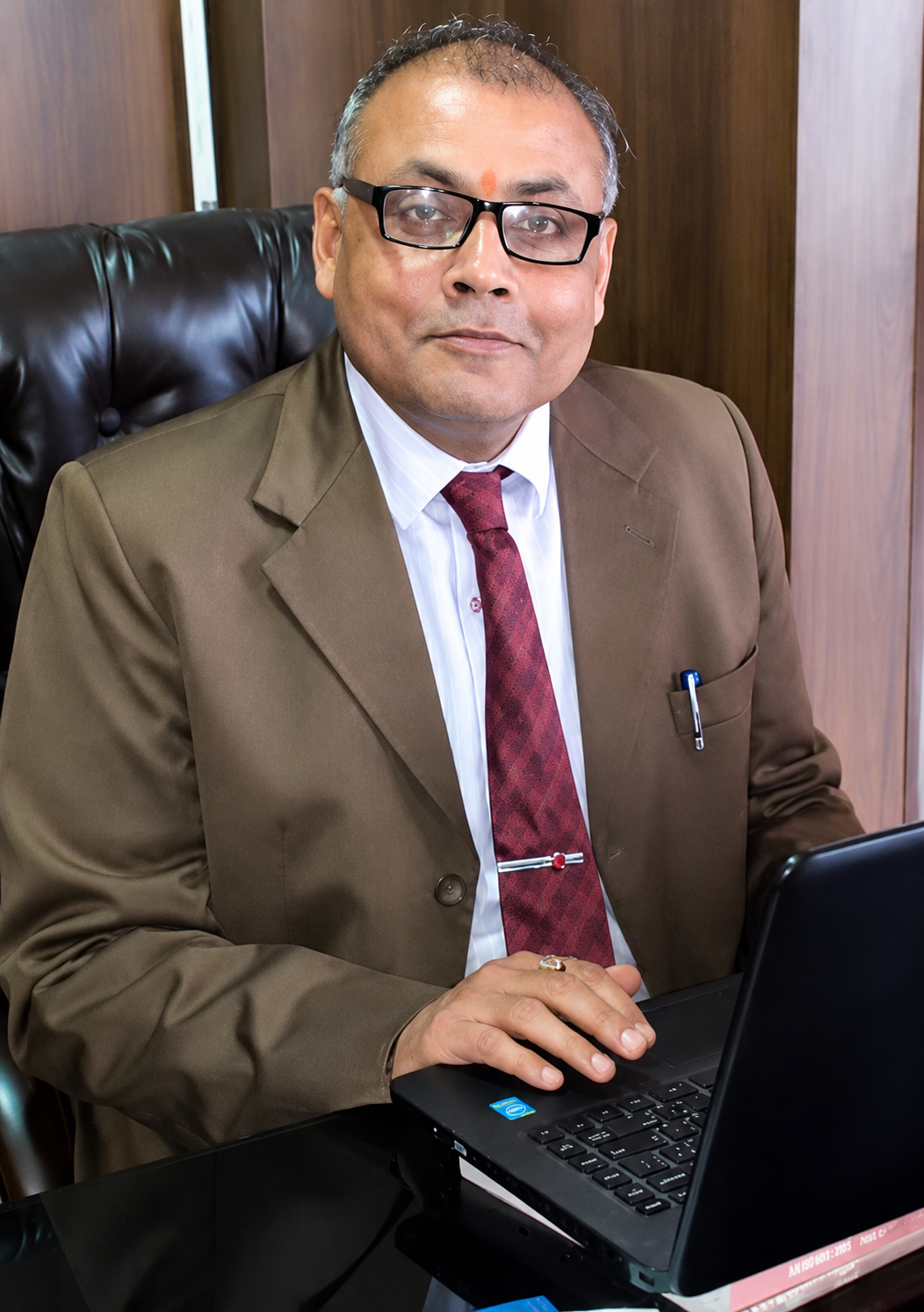
DR. SUBODH KUMAR
Professor of Chemistry • Academic Administrator • Researcher in Inorganic & Organometallic Chemistry
A LIFE DEDICATED TO CHEMISTRY, RESEARCH, AND HIGHER EDUCATION
Dr. Subodh Kumar is an eminent Indian academician, distinguished research chemist, educator, and higher education administrator whose remarkable professional journey spans more than three decades across India, Europe, East Asia, and Africa. Throughout his career, he has remained committed to advancing scientific knowledge, promoting excellence in higher education, and nurturing generations of students and young researchers in the field of chemistry. His life represents a rare combination of scientific excellence, international academic exposure, visionary educational leadership, and unwavering dedication to public service through education.
Born on 16 February 1966 in the village of Khokhra, located in East Champaran district of Bihar, Dr. Kumar's early years were shaped by the values of perseverance, discipline, and intellectual curiosity. Raised in an environment that emphasized education as the path toward social progress, he developed an enduring fascination for science during his school years. This fascination eventually evolved into a lifelong commitment to chemistry—a discipline through which he has contributed significantly as a researcher, teacher, mentor, and institution builder.
Today, while serving as Principal of SRJSSS College, Muzaffarpur, he continues to inspire students, faculty members, and researchers alike. His professional journey—from a research scholar in India to an internationally respected professor working across four continents—stands as a testament to his academic excellence and global outlook.
EARLY LIFE AND EDUCATIONAL FOUNDATION
Growing up in rural Bihar, Dr. Kumar understood firsthand the transformative power of education. Despite the limited educational infrastructure available in many rural regions during the 1970s and 1980s, he excelled academically and consistently demonstrated exceptional aptitude in science. His dedication earned him admission to some of India's respected institutions for higher education in chemistry.
He completed his Bachelor of Science (Honours) in Chemistry from M.S. College, Motihari, under Bihar University, Muzaffarpur, graduating with distinction. His academic brilliance continued during his postgraduate studies, where he obtained an M.Sc. in Inorganic Chemistry, securing First Class with Distinction—an achievement that reflected both his intellectual capability and deep understanding of chemical sciences.
Determined to pursue advanced scientific research, Dr. Kumar joined the School of Chemical Sciences at Devi Ahilya Vishwavidyalaya (DAVV), Indore, where he was awarded prestigious DST and CSIR fellowships. Under this highly competitive national research programme, he completed his Ph.D. in Inorganic and Organometallic Chemistry in 1995, laying the foundation for an internationally recognized research career.
Recognizing the growing importance of environmental sustainability, he further enhanced his academic credentials by earning a Postgraduate Diploma in Environmental Impact Assessment from A.P.S. University, Rewa in 2000, broadening his expertise beyond traditional chemistry into environmental science and sustainable development.
THE BEGINNING OF A DISTINGUISHED RESEARCH CAREER
Immediately after completing his doctorate, Dr. Kumar embarked upon an intensive research career within India's premier scientific research ecosystem. During the following fifteen years, he worked with several of the country's leading scientific institutions, collaborating with internationally respected scientists and contributing to cutting-edge research in inorganic chemistry, organometallic chemistry, catalysis, electrochemistry, materials science, and related interdisciplinary fields.
His research appointments included prestigious positions at:
-
National Chemical Laboratory (NCL), Pune
-
Central Electrochemical Research Institute (CECRI), Karaikudi
-
Indian Institute of Technology Delhi
-
Indian Institute of Technology Bombay
-
Indian Institute of Technology (ISM), Dhanbad
-
National Institute of Immunology (NII), New Delhi
-
Banasthali University
-
A.P.S. University, Rewa
These appointments enabled him to participate in nationally significant research programmes funded by organizations such as the Council of Scientific and Industrial Research (CSIR), the Department of Science and Technology (DST), the Department of Biotechnology (DBT), and other premier scientific agencies.
Throughout these years, Dr. Kumar established himself as a versatile researcher capable of bridging fundamental chemical science with practical applications. His work explored the synthesis, characterization, structural behaviour, catalytic properties, and applications of inorganic and organometallic compounds, contributing to the advancement of chemical research in India.
INTERNATIONAL RESEARCH AND GLOBAL SCIENTIFIC COLLABORATION
Dr. Kumar's academic excellence earned him several prestigious international opportunities that significantly expanded both his research horizons and professional reputation.
One of the defining milestones in his career was his selection as a Postdoctoral Fellow at the University of Aveiro, Portugal, under the highly regarded Fundação para a Ciência e a Tecnologia (FCT) programme. Working within one of Europe's leading chemistry research environments, he collaborated with internationally renowned scientists and gained valuable exposure to advanced laboratory techniques, modern instrumentation, and international research methodologies.
Soon afterward, he was invited as a Professorial Visiting Fellow at Andong National University, South Korea, where he continued collaborative research while engaging in advanced teaching and academic exchange. This appointment reflected international recognition of his expertise and enabled him to establish long-lasting collaborations with researchers across Asia.
His international experience greatly enriched his scientific perspective, allowing him to integrate global best practices into his subsequent teaching, research supervision, and academic administration.
A TRANSFORMATIVE CHAPTER IN AFRICA: BUILDING A RESEARCH UNIVERSITY
Among the most remarkable chapters of Dr. Kumar's professional life was his appointment in 2010 as Professor of Chemistry under the United Nations Development Programme (UNDP) Chair at Arba Minch University, Ethiopia.
Over the next eight years, he played a transformative role in strengthening chemistry education and research within the university. Beyond classroom teaching, he became one of the principal architects of the institution's postgraduate and research ecosystem.
As the Founding Professor of the Postgraduate and Research Programme, Dr. Kumar contributed to:
-
Establishing postgraduate chemistry curricula.
-
Designing advanced laboratory infrastructure.
-
Developing research programmes aligned with international standards.
-
Supervising postgraduate research scholars.
-
Mentoring young faculty members.
-
Promoting collaborative research culture.
-
Introducing modern approaches to laboratory instruction.
-
Strengthening institutional academic governance.
His leadership helped transform the Department of Chemistry into a vibrant centre for higher learning and scientific research. Students trained under his guidance have gone on to pursue successful careers in academia, research laboratories, government institutions, and industry.
His eight-year tenure remains one of the most significant examples of international academic capacity building by an Indian scientist.
ACADEMIC LEADERSHIP IN INDIA
Following his successful international assignments, Dr. Kumar returned to India and continued contributing to higher education through institutional leadership.
He first served as Professor and Principal at SGITM, Ahera (Baghpat, Uttar Pradesh), where he focused on improving academic quality, faculty development, student engagement, and institutional administration.
In 2021, he assumed the position of Principal of SRJSSS College, Muzaffarpur, a constituent college affiliated with Babasaheb Bhimrao Ambedkar Bihar University (BRABU). As Principal, he has emphasized academic excellence, transparent governance, research promotion, digital transformation, quality assurance, and student-centred education.
Under his leadership, the institution has worked toward strengthening classroom teaching, enhancing infrastructure, encouraging faculty research, expanding student support services, and fostering an environment that values both academic achievement and ethical responsibility.
AN INSPIRING TEACHER AND MENTOR
Teaching has always remained at the heart of Dr. Kumar's professional identity.
Across more than twenty-seven years of university teaching, he has taught undergraduate and postgraduate students in India, Ethiopia, Portugal, and South Korea. His teaching portfolio encompasses:
-
Inorganic Chemistry
-
Organometallic Chemistry
-
Coordination Chemistry
-
Catalysis
-
Environmental Chemistry
-
Engineering Chemistry
-
Instrumental Analysis
-
Materials Chemistry
-
Research Methodology
Known for his clarity of explanation and student-friendly teaching style, Dr. Kumar believes that chemistry should be understood conceptually rather than memorized mechanically. His classrooms encourage critical thinking, scientific reasoning, laboratory skills, and independent inquiry.
Many of his former students today serve as professors, researchers, industrial scientists, and administrators across various countries.
RESEARCH CONTRIBUTIONS
Dr. Kumar's research interests span several important domains of modern chemistry, particularly:
-
Inorganic Chemistry
-
Organometallic Chemistry
-
Coordination Chemistry
-
Catalysis
-
Electrochemistry
-
Materials Chemistry
-
Environmental Chemistry
Over the course of his career, he has authored 34 research publications in reputed scientific journals and conference proceedings. His work has contributed to a deeper understanding of transition metal complexes, catalytic systems, structural chemistry, and environmentally relevant chemical processes.
Beyond publications, he has actively supervised postgraduate dissertations, guided research scholars, participated in sponsored research projects, reviewed scientific work, and contributed to academic discussions at national and international conferences.
HONOURS, FELLOWSHIPS, AND PROFESSIONAL DISTINCTIONS
Dr. Kumar's scientific achievements have been recognized through numerous prestigious fellowships and research appointments throughout his career.
These include:
-
Junior Research Fellowship (DST)
-
Senior Research Fellowship (CSIR)
-
Research Associateships under CSIR programmes
-
Research Scientist appointment at IIT Delhi
-
Postdoctoral Fellowship (University of Aveiro, Portugal)
-
Visiting Professorial Fellowship (Andong National University, South Korea)
-
National Pool Scientist (CSIR)
-
Senior Research Associateship at CECRI and IIT Bombay/IIT (ISM)
-
Indian National Science Academy (INSA) Summer Scientist Fellowship
-
Research collaboration with the R&D Centre of IPCL (Reliance Industries Limited)
These honours reflect sustained recognition by leading scientific organizations in India and abroad.
ACADEMIC PHILOSOPHY
Throughout his career, Dr. Kumar has maintained that the true purpose of higher education extends beyond awarding degrees. He believes universities must cultivate scientific curiosity, ethical responsibility, critical thinking, innovation, and social commitment.
As both scientist and administrator, he has consistently advocated for research-driven teaching, interdisciplinary collaboration, international academic exchange, and the integration of modern technology into higher education.
His philosophy emphasizes that great institutions are built not merely through infrastructure but through dedicated teachers, motivated students, and a culture of academic integrity.
PERSONAL LIFE
Despite his extensive international career, Dr. Kumar has remained deeply connected to his roots in Bihar. He continues to reside at Sri Krishna Nagar, Motihari, in East Champaran district—the region where his educational journey first began.
He is married and is the proud father of one son. Friends, colleagues, and students describe him as humble, disciplined, approachable, and deeply committed to both scholarship and public service. Outside the laboratory and classroom, he values lifelong learning, mentorship, and the advancement of quality education in society.
LEGACY AND CONTINUING CONTRIBUTION
Dr. Subodh Kumar's career represents an extraordinary blend of scientific scholarship, international research, educational leadership, and institution building. From the classrooms of Bihar to the laboratories of Portugal, from collaborative research in South Korea to the establishment of postgraduate education in Ethiopia, and finally back to academic leadership in India, his journey reflects the enduring impact of knowledge, perseverance, and service.
Over more than thirty years, he has educated thousands of students, mentored future scientists, strengthened universities across continents, and contributed meaningfully to the advancement of inorganic and organometallic chemistry. His life stands as an inspiring example of how dedication to science and education can transcend geographical boundaries while remaining firmly rooted in one's own community and nation.
Today, as an educator, researcher, administrator, and mentor, Dr. Subodh Kumar continues to shape the future of higher education and scientific research, leaving behind a legacy that will inspire generations of scholars to come.