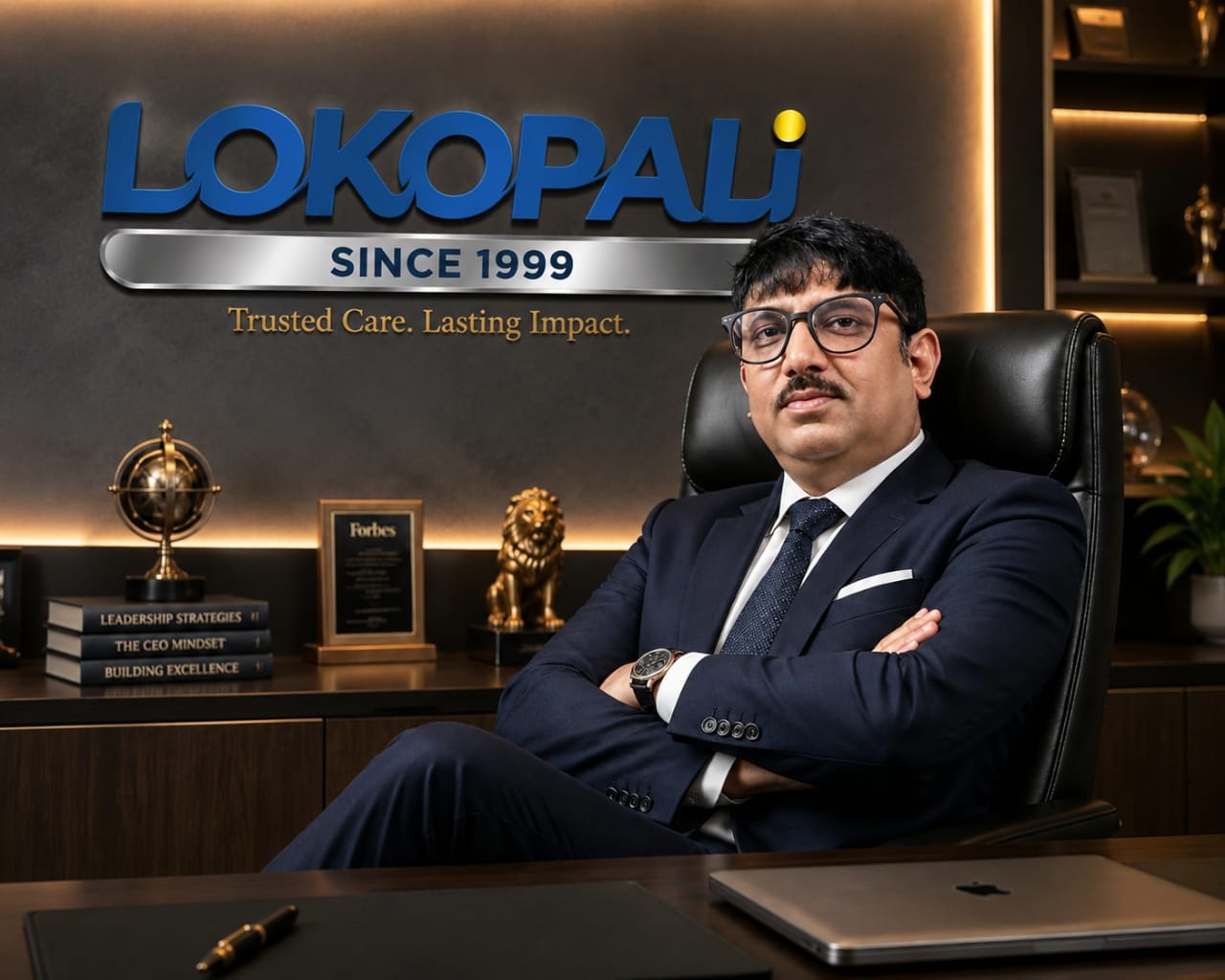
DEBAJYOTI DATTA
Founder & Proprietor, LOKOPALI Diagnostic Center
Founder-cum-CEO, LOKOPALI Healthcare Private Limited
Healthcare Entrepreneur | Diagnostic Services Pioneer | Rural Healthcare Advocate | Preventive Healthcare Visionary
“From a modest diagnostic laboratory established with limited resources to the vision of building an organized healthcare institution, Debajyoti Datta’s journey reflects perseverance, patient trust, affordability, learning and long-term commitment to accessible healthcare.”
Introduction
Debajyoti Datta is an Indian healthcare entrepreneur and the Founder & Proprietor of LOKOPALI Diagnostic Center and Founder-cum-CEO of LOKOPALI Healthcare Private Limited.
His entrepreneurial journey began on 15 December 1999, when he established LOKOPALI in a rented space of approximately 160–180 square feet, with limited capital, basic infrastructure and no significant financial backing.
What started as a small diagnostic laboratory gradually evolved through several stages—pathology services, advanced diagnostic facilities, rural healthcare outreach, public-private partnership initiatives, technology expansion, organized healthcare infrastructure and, ultimately, the creation of LOKOPALI Healthcare Private Limited.
For more than two decades, his work has been guided by a central belief:
Quality healthcare should not remain limited to large cities or financially privileged communities. It should be accessible, reliable and affordable for ordinary people.
This philosophy has shaped the growth of LOKOPALI and continues to influence its future direction toward diagnostics, preventive healthcare, early detection, digital health and community-focused medical services.
Early Life and Family Background
Debajyoti Datta was born on 7 March 1971.
He grew up in a modest family environment where education, discipline, responsibility and hard work were strongly valued.
His father, Shri Montu Chandra Datta, served as a primary school Head Teacher, while his mother, Rita Datta, played an important role in shaping the family environment in which he grew up.
Coming from a family with limited resources gave him an early understanding of financial discipline, perseverance and the importance of building a career through consistent personal effort.
These values later became central to his entrepreneurial life.

Educational Journey
Debajyoti Datta began his formal education at Indira Gandhi Primary School in 1976.
He later studied at Majdia Railbazar High School, completing his secondary and higher secondary education there.
Academic Timeline
-
1976 — Primary Education, Indira Gandhi Primary School
-
1980–1988 — Classes V–XII, Majdia Railbazar High School
-
1986 — Madhyamik Examination, West Bengal Board of Secondary Education
-
1988 — Higher Secondary Examination, West Bengal Council of Higher Secondary Education
-
1989–1992 — B.Com. (Honours), associated with Sudhiranjan Lahiry Mahavidyalaya and Dumdum Motijhil College of Commerce, University of Calcutta
-
1993–1994 — Post Graduate Diploma / MBA-level study in Marketing Management, Bhavan's College of Communication and Management
-
1994–1997 — M.Com., University of Burdwan, through distance mode
His background in commerce, marketing and management later helped him understand organizational economics, consumer behaviour, pricing, service delivery, procurement and business development.
However, much of his most influential learning would eventually come from practical experience in healthcare.
Family Background
Debajyoti Datta is the son of Late Mantu Chandra Datta. His personal journey, professional experiences and years of learning would later become part of the foundation from which he built his long-term vision in diagnostic and community healthcare.
Extension into Rural Community — Bagula, Haringhata
An important dimension of LOKOPALI’s growth has been its effort to extend healthcare services beyond conventional urban markets and move closer to rural communities.
As part of this rural expansion, Bagula, in the Haringhata region, became an important area in LOKOPALI’s community-oriented healthcare journey. This step reflected Debajyoti Datta’s continuing belief that dependable diagnostic and healthcare services should not remain concentrated only in major towns and cities, but should gradually become more accessible to people living in rural and underserved communities.
The expansion into Bagula strengthened the broader philosophy behind LOKOPALI—taking healthcare closer to ordinary people while building sustainable relationships with local communities.
DEBAJYOTI DATTA — A Continuing Journey Towards a Larger Healthcare Vision
DEBAJYOTI DATTA represents the name of a continuing journey—one that began with market surveys, evolved through entrepreneurship and diagnostic healthcare, expanded into rural communities, and is now moving towards a much larger healthcare vision.
From understanding markets and people to establishing and developing LOKOPALI, his journey has continuously evolved with experience, challenges, innovation and changing healthcare needs.
Today, that vision extends beyond operating diagnostic centres. The long-term ambition is to develop LOKOPALI Healthcare Private Limited into a professionally managed, scalable and institutionally governed healthcare organization, while progressively strengthening preventive healthcare, rural accessibility, digital capabilities and community-oriented services.
As part of this larger corporate vision, Debajyoti Datta also holds the long-term ambition of preparing LOKOPALI for a possible IPO and public-market journey, subject to the necessary corporate, financial, legal, governance and regulatory requirements.
It is not presented as a current listing or completed IPO, but as a future strategic direction—a goal of transforming LOKOPALI from a founder-led healthcare journey into an institution capable of achieving greater scale, transparency, professional governance and long-term sustainability.
What began with market surveys is now moving towards a larger healthcare vision—and the journey continues.
Beginning of His Professional Career
Debajyoti Datta began his professional journey around 1992.
Healthcare was not initially a predetermined career destination.
During the early phase of his career, he worked on different market research and survey assignments, many of which were project-based or part-time.
An important early association came through Uttar Management Service, where he came into contact with Mr. Deep Banerjee, a senior professional who influenced the direction of his early working life.
Travelling across Kolkata for surveys and interacting directly with people gave Debajyoti practical insight into:
-
Consumer behaviour
-
Trust
-
Communication
-
Service expectations
-
Affordability
-
Market psychology
-
Customer decision-making
These experiences helped him understand that successful service organizations are built not merely around products, but around human behaviour and trust.

Entering the World of Diagnostic Healthcare
Around 1993–94, Debajyoti became associated with survey and marketing work connected with a diagnostic centre.
At that time, diagnostic technologies such as Ultrasonography were still developing in awareness and reach among many communities.
What began as market research gradually expanded into healthcare service marketing and business development.
During this phase, Debajyoti came to understand that diagnostic healthcare was fundamentally different from conventional product marketing.
For him, effective healthcare required the integration of:
Technology + Medical Expertise + Technical Accuracy + Patient Trust + Communication + Service Quality
He realized that sophisticated equipment alone could not create a respected healthcare institution.
Nor could aggressive marketing compensate for poor quality.
Trust had to be earned through accurate service and consistent professionalism.
This understanding became one of the philosophical foundations of LOKOPALI.
From Employee to Entrepreneur
While working in the diagnostic healthcare sector, Debajyoti began studying the economics behind diagnostic services.
He observed how institutions managed equipment, pricing, technical services, referrals and patient relationships.
Gradually, he began questioning his own professional future.
He wanted to build an institution of his own.
The challenge was substantial.
He had limited capital, family responsibilities and no major financial cushion.
Healthcare itself required specialized knowledge, machines, laboratory infrastructure and trained manpower.
Debajyoti therefore began expanding his understanding beyond marketing.
He acquired practical exposure and training connected with laboratory technology, DMLT, DMRT and radiology-related diagnostic work, learning from experienced technicians, doctors and radiologists.
This became the transition from marketing healthcare services to understanding how those services were actually delivered.

15 December 1999 — The Birth of LOKOPALI
On 15 December 1999, Debajyoti Datta formally began his own diagnostic initiative under the name LOKOPALI.
The beginning was exceptionally modest.
The laboratory operated from approximately 160–180 square feet of rented space.
There was little capital available for:
-
Furniture
-
Laboratory equipment
-
Electrical installations
-
Interiors
-
Basic operational infrastructure
His father, being a primary school teacher, was unable to provide substantial financial support.
His sister helped wherever possible, while several expenses had to be managed gradually and through instalments.
There was no large financial reserve behind the venture.
LOKOPALI had to survive through the work it generated.
The First Six Months — Survival Before Growth
The first six months tested Debajyoti’s determination intensely.
On certain days, total earnings could be as low as ₹30, ₹50 or ₹100.
On comparatively better days, collections might reach around ₹500–₹700.
The organization did not initially even have enough resources for a typewriter.
Debajyoti personally collected samples during the day, returned to the laboratory and carried out testing in the evening.
Work frequently continued until 9 PM, 10 PM or 11 PM.
Reports were maintained manually through notebooks and registers.
There were no smartphones, sophisticated laboratory information systems or modern digital reporting platforms.
When computerized typing was required, he travelled by train to Ranaghat, where even the typing of an individual report involved an additional cost.
Yet one principle remained non-negotiable:
The laboratory might be small, but the standard of its work and presentation should never appear small.
This philosophy became an early part of the LOKOPALI identity.
Building Trust Through Professionalism
With the help of a friend, LOKOPALI developed professional letterheads and envelopes.
Computer-printed reports were used whenever possible.
For Debajyoti, these details were not merely cosmetic.
They represented credibility.
He understood very early that professionalism depended upon consistency in:
-
Diagnostic quality
-
Reporting
-
Presentation
-
Communication
-
Patient service
-
Doctor relationships
-
Reliability
Gradually, patients began returning.
Doctors became more confident in the reports.
LOKOPALI began building an asset that would become more important than early financial success:
Trust.
Quality Before Scale
One incident became particularly significant in reinforcing Debajyoti’s belief in quality.
A patient received a triglyceride result of approximately 186 from LOKOPALI.
The following day, the patient underwent another test at a large Kolkata hospital and received a nearly identical result.
For Debajyoti, the experience carried considerable meaning.
It demonstrated that a small diagnostic laboratory could establish credibility when the accuracy of its services stood up to comparison with much larger institutions.
It strengthened his conviction that healthcare organizations should grow through quality and reliability, rather than scale alone.
The Flood of 2000 — Healthcare Beyond Commerce
Severe flooding in 2000 disrupted healthcare and daily life across several areas.
Doctors worked under difficult conditions, sometimes using temporary arrangements and makeshift treatment facilities.
Debajyoti remained actively connected with doctors and healthcare services during this period.
He travelled through waterlogged areas and sometimes remained engaged in field activity for almost 20 hours in a day.
The experience transformed many of his professional relationships.
Doctors were no longer simply commercial contacts.
They became colleagues within a shared healthcare mission.
This period reinforced another important principle:
Healthcare is ultimately about serving people, particularly when circumstances become difficult.
Technology Expansion — 2004
By around 2004, LOKOPALI began expanding beyond basic pathology services.
New diagnostic capabilities included:
-
Ultrasonography
-
X-Ray
-
ECG
One of its early ultrasound systems was a GE Logiq Alpha 100 MP, acquired through an EMI arrangement.
An X-ray machine was also acquired through financing, and LOKOPALI became associated with an early installation in the Nadia region involving an Allengers 100 mA X-ray system.
Technical manpower remained limited.
Specialized technicians sometimes visited only on scheduled days.
Rather than allowing this limitation to halt progress, Debajyoti learned directly from technical professionals and expanded his own practical understanding.
He also obtained relevant experience certification and pursued DMRT-related training and examination.
His approach reflected a recurring feature of his career:
Whenever financial resources were limited, knowledge and learning became instruments of growth.
A Commitment to Rural Healthcare
Major diagnostic providers at the time were generally concentrated around larger urban centres such as:
-
Ranaghat
-
Krishnanagar
-
Kalyani
Large parts of rural Nadia continued to face limited access to diagnostic healthcare.
Residents from places including Palashipara, Maheshganj, Bishnupur, Majdia and surrounding rural communities frequently had to travel significant distances for medical investigations.
Coming from a rural background himself, Debajyoti understood this difficulty personally.
He did not view rural healthcare purely as a difficult market.
He saw it as an access challenge.
This shaped one of the defining principles of LOKOPALI:
A patient should not be denied access to quality diagnostic healthcare simply because they live in a village.
The Bicycle Years
Before motorcycles and cars became part of the organization’s operations, Debajyoti frequently travelled by bicycle to collect diagnostic samples.
Some journeys covered approximately 17–18 kilometres into rural areas.
Village visits were sometimes arranged on fixed days.
Patient numbers could be limited.
Financial returns could be modest.
But Debajyoti continued.
These years became symbolic of the grassroots character of the LOKOPALI journey.
The organization grew not by waiting for every patient to come to it, but by finding ways to take healthcare closer to the patient.
The 2006 Survey and a Turning Point
In 2006, a healthcare organization conducted a study of diagnostic services across Nadia.
The survey examined diagnostic centres, available services and healthcare delivery patterns.
Debajyoti’s earlier experience in market research became unexpectedly valuable.
He participated in the process without initially knowing its long-term implications.
He subsequently received communication confirming his selection for a Public-Private Partnership project.
This marked a significant turning point.
He proceeded through the required Expression of Interest process, visited Health Bhavan, complied with applicable terms and conditions and ultimately entered the PPP diagnostic services space.
Entering Public-Private Partnership Healthcare
Around 2007, LOKOPALI began participating in Public-Private Partnership diagnostic services connected with hospital premises.
This allowed the organization to operate within a structured healthcare environment using government-associated infrastructure and government-defined pricing mechanisms.
The experience gave Debajyoti deeper insight into healthcare economics.
He learned that affordability had to coexist with:
-
Equipment investment
-
Employee salaries
-
Maintenance
-
Procurement
-
Logistics
-
Patient volume
-
Competition
-
Operational costs
-
Long-term sustainability
The experience shaped an important conclusion:
Affordable healthcare must also be financially sustainable if it is expected to serve people consistently over the long term.
Expansion Across Rural Communities
Following its initial PPP experience, LOKOPALI became associated with projects in areas including:
-
Maheshganj
-
Bishnupur
-
Palashipara
-
Harinhata
The organization gradually developed a broader rural diagnostic footprint.
LOKOPALI was no longer only a single laboratory.
It was evolving into a healthcare service network connected with communities that had historically experienced limited access to organized diagnostic services.
Understanding Healthcare Economics — 2012
By approximately 2012, LOKOPALI had expanded to around 15–16 staff members and was operating across multiple PPP centres.
Expansion brought new financial challenges.
One of them was procurement.
Debajyoti began travelling to Kolkata, including the Central Avenue area, to understand differences between distributor pricing and direct procurement opportunities.
LOKOPALI gradually moved toward more efficient and bulk purchasing.
An early bulk procurement was valued at approximately ₹50,000.
This stage taught another enduring business lesson:
Affordable healthcare is not created merely by reducing patient prices. It also requires disciplined procurement and intelligent cost management.
The Dengue Testing Experience
During the same broader period, dengue testing was emerging as an increasingly important diagnostic requirement.
A distributor introduced dengue testing kits to LOKOPALI.
The centre initially purchased approximately two boxes.
Debajyoti discussed the availability of the tests with doctors.
Doctors began prescribing them.
Positive cases emerged.
Demand increased considerably.
Supplies that initially arrived approximately once a week eventually had to be replenished several times a week.
At one stage, demand reportedly reached approximately 15–20 boxes per day.
The experience illustrated an important difference between ordinary business demand and healthcare demand.
In healthcare, demand can emerge suddenly from a public-health requirement.
The responsibility of a diagnostic institution is therefore not merely to sell, but to identify need and respond responsibly.
Growth, Competition and Organizational Pressure
Between approximately 2017 and 2019, diagnostic collection networks expanded and larger organized players became increasingly active in the market.
Collection centres became more widespread.
Competition intensified.
Recruitment and employee retention became more difficult.
Debajyoti experienced periods when he questioned whether the organization was progressing at the pace he had expected.
Yet LOKOPALI continued.
Rather than abandoning the journey during periods of uncertainty, he used changing market conditions as opportunities to reconsider the organization’s operating model.
Mobility as an Instrument of Healthcare Expansion
The organization’s transport infrastructure evolved alongside its healthcare operations.
Around 2006, a motorcycle became part of the operational network.
In 2016, a Maruti Swift was added.
For LOKOPALI, these vehicles were not merely symbols of financial progress.
They were practical operating assets.
They supported:
-
Sample transportation
-
Rural healthcare outreach
-
Doctor visits
-
Material movement
-
Centre coordination
-
Business operations
Each stage of physical expansion remained closely connected with healthcare delivery.
COVID-19 — A Defining Test of Resilience
The COVID-19 pandemic created an unprecedented challenge for healthcare institutions.
Transportation systems were disrupted.
Trains and buses stopped operating normally.
Healthcare centres faced restrictions and uncertainty.
During this period, doctors contacted Debajyoti to determine whether LOKOPALI could continue providing diagnostic services.
The organization adapted its infrastructure and introduced enhanced measures relating to:
-
Patient waiting
-
Screening
-
Patient movement
-
Infection-control precautions
-
Service continuity
Diagnostic demand increased substantially.
At one stage, LOKOPALI was reportedly handling approximately 100–150 ultrasound examinations per day.
Whole Abdomen ultrasonography was offered at approximately ₹800, later around ₹1,000, while some comparable private-market rates could reach approximately ₹1,500–₹1,600.
For Debajyoti, maintaining affordability during a public-health crisis remained an important priority.
The COVID period became another defining chapter in the institutional journey.
It demonstrated that healthcare institutions are judged not merely during periods of expansion, but also during periods of social and operational uncertainty.
Evolution from Diagnostic Centre to Healthcare Company
Following the COVID period, Debajyoti began looking beyond the traditional diagnostic-centre model.
By then, his career had exposed him to practically every major aspect of diagnostic healthcare operations:
-
Pathology
-
Diagnostic imaging
-
Rural healthcare
-
Patient behaviour
-
Doctor engagement
-
Procurement
-
Pricing
-
Marketing
-
Human resources
-
Infrastructure
-
Public-private partnerships
-
Operational sustainability
This accumulated experience generated a larger question:
Could LOKOPALI evolve from a collection of diagnostic services into a professionally structured healthcare institution?
That question eventually led to the creation of a new corporate entity.
LOKOPALI Healthcare Private Limited — 2022
In June 2022, LOKOPALI Healthcare Private Limited was formed.
The development represented a major institutional transition:
Pathology Laboratory → Diagnostic Centre → Rural Healthcare Network → PPP Healthcare Services → Organized Healthcare Company
Approximately ₹1.5 crore in financial investment or commitment was directed toward infrastructure development.
Debajyoti has remained transparent about the organization’s current stage.
The company is still being developed toward the scale envisioned by its founder.
A substantial portion of available capital has already been directed toward infrastructure.
Further resources, professional management, operational activation, team development and organizational systems are required to bring the company to its intended level.
For Debajyoti, the incorporation of the company is therefore not the conclusion of the journey.
It represents the beginning of its next institutional phase.
Founder-cum-CEO — A New Leadership Role
With the establishment of LOKOPALI Healthcare Private Limited, Debajyoti’s role expanded from diagnostic-centre proprietor to Founder-cum-CEO of a broader healthcare organization.
The objective is no longer limited to operating individual diagnostic facilities.
The larger vision is to integrate:
Diagnostics + Prevention + Early Detection + Health Awareness + Digital Health + Community Healthcare + Affordable Access
The philosophy is gradually evolving from simply:
“Diagnose the disease.”
toward:
“Prevent where possible, detect early, diagnose accurately and help people manage their health more effectively.”
LOKOPALI Preventive Healthcare Foundation
Following the formation of the company, LOKOPALI Preventive Healthcare Foundation was created to support the broader preventive and community-health vision.
The initiative reflects Debajyoti’s belief that healthcare should not begin only after serious illness develops.
The broader vision includes:
-
Preventive health awareness
-
Screening
-
Early detection
-
Lifestyle education
-
Community healthcare
-
Health management
The long-term objective is to combine healthcare capability with meaningful preventive and community-focused initiatives.
The Philosophy Behind LOKOPALI
For Debajyoti Datta, LOKOPALI represents far more than a commercial brand.
It is the result of decades of:
-
Struggle
-
Financial risk
-
Continuous learning
-
Doctor support
-
Employee contribution
-
Family support
-
Patient confidence
-
Community relationships
-
Innovation
-
Persistence
There were moments when the organization could have focused primarily on higher margins or commercially more attractive locations.
Instead, an important part of its identity remained connected with affordability and access.
That choice may have affected the speed at which personal or corporate wealth accumulated.
But it created something Debajyoti considers equally important:
Long-term institutional trust.
A Different Definition of Success
Debajyoti Datta does not measure achievement only through personal wealth.
For him, healthcare entrepreneurship carries a broader responsibility.
His own measure of success includes questions such as:
-
How many people trusted the institution?
-
How many communities received access to diagnostic healthcare?
-
How many doctors were able to depend on its services?
-
How many staff members grew with the organization?
-
How consistently could quality be maintained?
-
Can the institution continue serving future generations?
This perspective defines much of his entrepreneurial philosophy.
Success, in his view, is not only about financial accumulation.
It is also about building an institution capable of creating lasting social and healthcare value.
The Road Ahead
LOKOPALI has now entered another stage of transition.
The infrastructure has been developed.
Decades of operating experience have been accumulated.
The organization has worked through multiple healthcare delivery models.
The next objective is to bring these resources together within a stronger and more scalable organizational framework.
Key priorities include:
-
Strengthening the professional management team
-
Activating available healthcare infrastructure
-
Improving operational efficiency
-
Expanding community outreach
-
Strengthening diagnostic services
-
Developing preventive healthcare programmes
-
Expanding digital healthcare capability
-
Building sustainable rural healthcare models
-
Improving the overall patient experience
-
Establishing stronger organizational systems and governance
The goal is not simply to make LOKOPALI larger.
The goal is to make it:
Stronger. More organized. More accessible. More sustainable.
Preparing for a Larger Corporate Future
Among Debajyoti Datta’s long-term ambitions is the preparation of LOKOPALI for a possible future IPO and public-market journey, subject to the necessary corporate, financial, legal, regulatory and governance requirements.
This remains a future ambition rather than a completed listing or current public-market status.
The larger purpose of such preparation is to transform LOKOPALI from a predominantly founder-driven enterprise into a professionally governed healthcare institution built around:
-
Transparency
-
Accountability
-
Corporate governance
-
Financial discipline
-
Scalable systems
-
Professional management
His long-term vision is to build an organization capable of becoming larger than its founder and sustainable beyond individual leadership.
Lessons from the Journey
Looking back at his career, every phase contributed something important to Debajyoti’s understanding of entrepreneurship and healthcare.
Market research taught him about people.
Marketing taught him communication.
Diagnostics taught him responsibility.
Rural outreach taught him accessibility.
PPP healthcare taught him the balance between affordability and sustainability.
Procurement taught him cost discipline.
Competition taught him adaptability.
COVID-19 taught him resilience.
Corporate formation taught him the importance of structure and scale.
The current phase is teaching him organizational transformation.
Legacy and Continuing Vision
The journey from a 160–180 square foot laboratory in 1999 to LOKOPALI Healthcare Private Limited has never followed a simple or predictable path.
It has included days when revenues were only a few hundred rupees.
It has included bicycle journeys to rural villages.
It has included diagnostic machines purchased through EMI.
It has included financial uncertainty, competitive pressure, rural outreach, public-private partnerships and public-health crises.
Yet the institution continued to evolve.
From manual registers to organized diagnostic systems.
From a rented room to healthcare infrastructure.
From one laboratory to rural healthcare projects.
From a proprietorship to a private limited company.
From diagnosis toward prevention.
This is the larger meaning of the LOKOPALI story.
Conclusion — The LOKOPALI Story Continues
More than two decades after its establishment, LOKOPALI remains a work in progress.
It began with a small room.
It grew through personal effort.
It survived through patient confidence.
It expanded through technology.
It reached rural communities.
It entered PPP healthcare.
It faced changing markets and financial pressure.
It continued delivering services through the extraordinary circumstances of COVID-19.
It evolved into LOKOPALI Healthcare Private Limited.
It expanded its vision through the LOKOPALI Preventive Healthcare Foundation.
And it now looks toward a future combining:
Diagnosis • Prevention • Early Detection • Awareness • Accessibility • Digital Healthcare • Long-Term Health Management
The original question that inspired the journey continues to remain relevant:
Can quality healthcare be brought closer to ordinary people?
For Debajyoti Datta, the answer is not merely spoken.
It is being built.
One patient.
One service.
One community.
One team.
One step at a time.
And that continuing journey is LOKOPALI.