✦ VERTOTECH AEROSPACE LIMITED ✦
Engineering the Future of Aerospace
Aerospace Engineering • Space Technologies • Launch Vehicles • UAV & Autonomous Systems • Advanced Manufacturing • Strategic Technologies
“Innovation. Sovereignty. Reliability.”
⸻
1. Company Overview
Vertotech Aerospace Limited is an Indian aerospace and advanced-engineering enterprise established with the objective of developing indigenous capabilities across aerospace systems, space technologies, launch vehicles, unmanned aerial systems, autonomous technologies, advanced manufacturing, aerospace structures and strategic engineering.
The company was incorporated on 9 February 2024 and operates as a registered Indian MSME.
Vertotech Aerospace is developing an integrated engineering and manufacturing ecosystem intended to progress from research and conceptual engineering through digital simulation, subsystem development, structural engineering, manufacturing, integration, testing, validation and future scalable production.
Its long-term strategy is based on building domestic engineering depth rather than concentrating exclusively on a single aircraft, UAV or launch vehicle.
The company’s principal technology philosophy is:
Research → Engineering → Simulation → Manufacturing → Integration → Testing → Validation → Capability
⸻
2. Corporate Identity
Particular Description
Company Vertotech Aerospace Limited
Incorporated 9 February 2024
Country India
Industry Aerospace & Advanced Engineering
Corporate status Registered MSME
Primary domains Aerospace, Space, UAVs, Autonomous Systems, Launch Vehicles, Advanced Manufacturing
Quality orientation AS9100D-oriented aerospace quality systems
Defence manufacturing framework SAMAR
Core philosophy Innovation • Sovereignty • Reliability
Manufacturing presence Karnataka
Strategic expansion Aerospace, space, defence and advanced manufacturing
⸻
3. Strategic Vision
Vertotech Aerospace’s long-term vision is to develop into an Indian aerospace and strategic-technology enterprise capable of contributing across multiple layers of the aerospace value chain.
The company’s development areas include:
* Aerospace systems engineering
* Launch-vehicle engineering
* Space and orbital systems
* UAV development
* Autonomous aerospace systems
* Advanced avionics
* Aerospace structures
* Composite materials
* Thermal engineering
* Digital engineering
* AI-assisted simulation
* Precision manufacturing
* Aerospace testing and validation
* Strategic defence technologies
The company seeks to build indigenous engineering and manufacturing capabilities that can support progressively more sophisticated aerospace programmes.
⸻
4. The Vertotech Development Model
The company’s engineering philosophy is structured around an integrated development cycle:
Concept
↓
Mission Architecture
↓
Digital Engineering
↓
CFD / FEA / Simulation
↓
Subsystem Development
↓
Prototype Manufacturing
↓
Integration
↓
Ground Testing
↓
Qualification
↓
Flight Demonstration
↓
Production
This approach is intended to establish controlled feedback between engineering design, manufacturing and testing.
⸻
5. Space and Launch-Vehicle Programmes
Space-launch technology represents one of Vertotech Aerospace’s principal long-term development areas.
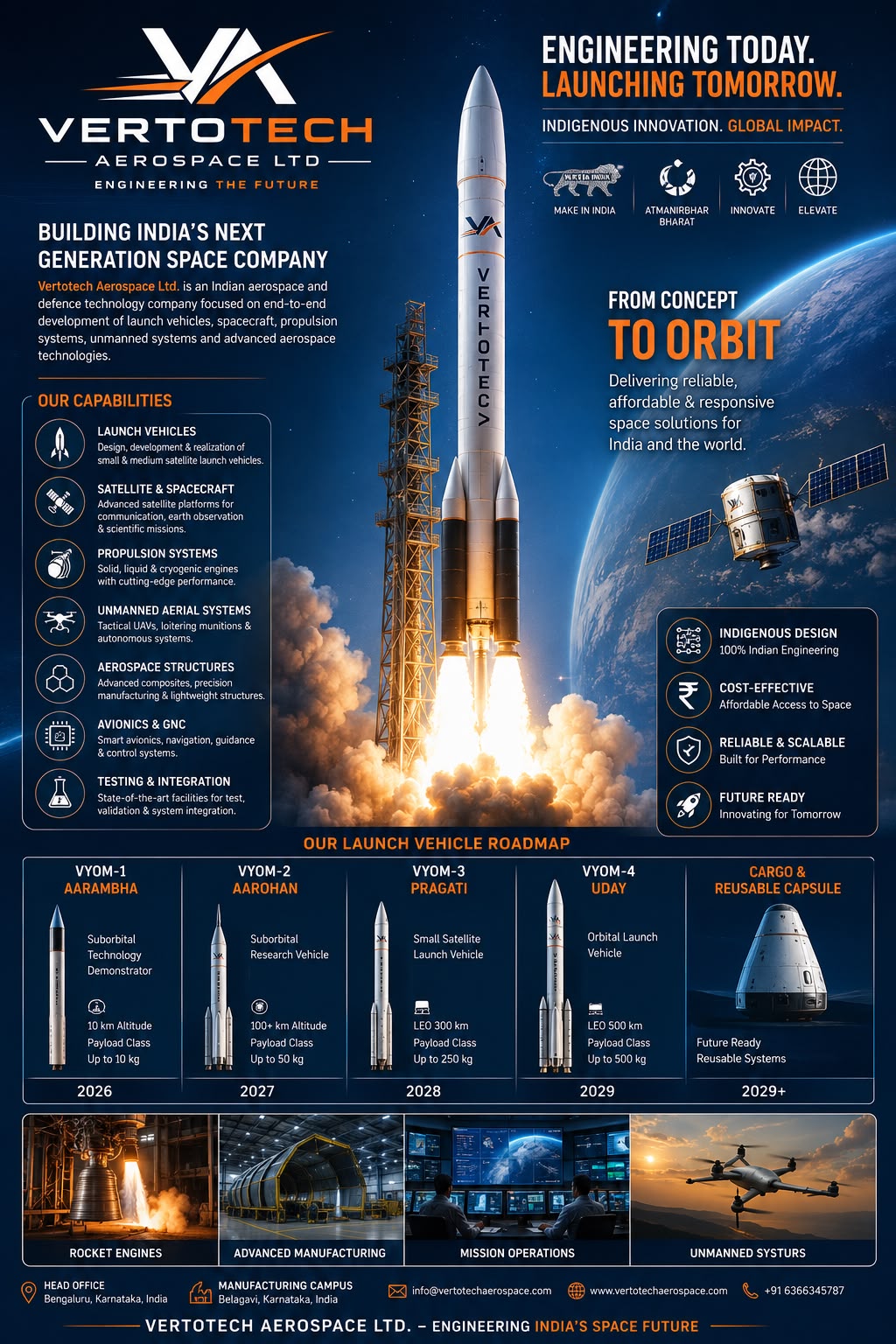
The company’s launch-vehicle roadmap is structured around progressively increasing mission complexity.
The current strategic sequence comprises:
1. VYAANA AAROHAN-1 / TDV-1 — approximately 10-km-class suborbital technology demonstration
2. 200-km-class suborbital research vehicle — approximately 50-kg-class payload target
3. Future orbital launch vehicle programme — targeted toward 2029
These programmes are intended to progressively develop capabilities in:
* Vehicle systems engineering
* Propulsion
* Avionics
* Guidance and control
* Telemetry
* Structures
* Payload integration
* Recovery technologies
* Mission simulation
* Ground-support systems
* Manufacturing and integration
All launch programmes remain subject to applicable technical qualification, range, safety and Indian regulatory approvals.
⸻
6. VYAANA AAROHAN-1 / TDV-1
VYAANA AAROHAN-1, also referred to as the company’s TDV-1 technology-demonstration vehicle, is planned as the first flight programme in the company’s launch-vehicle development roadmap.
Planned Mission Profile
* Vehicle family: VYAANA / AAROHAN
* Vehicle: AAROHAN-1 / TDV-1
* Mission: Suborbital technology demonstration
* Target altitude: approximately 10 km
* Payload: CanSat-class demonstration payload
* Target launch period: November 2026
* Programme purpose: Technology and systems demonstration
The initial mission is intended to provide flight experience in vehicle integration, avionics, telemetry, flight dynamics, mission operations and recovery/payload operations.
The programme should be understood as a technology-demonstration and development milestone, rather than an operational orbital launch service.
⸻
7. 200-km Suborbital Research Programme
The next major step in the launch roadmap is a planned 200-km-class suborbital vehicle.
The programme has a target payload capability of approximately 50 kg and is presently associated with a development horizon toward the end of 2027.
Potential applications include:
* Scientific research
* Microgravity experiments
* Technology demonstrations
* Aerospace component testing
* Payload qualification
* Atmospheric research
* Educational and research payloads
The programme is intended to bridge the company’s initial low-altitude demonstration and its longer-term orbital launch ambitions.
⸻
8. Future Orbital Launch Programme
Vertotech Aerospace’s longer-term roadmap includes development of an orbital launch vehicle targeted toward 2029.
The orbital programme is intended to develop capability in:
* Multi-stage launch-system architecture
* Propulsion integration
* Guidance, navigation and control
* Avionics
* Telemetry
* Structural systems
* Payload integration
* Ground-support infrastructure
* Mission planning
* Launch operations
The orbital programme remains a future development objective and is subject to detailed engineering design, qualification, financing, infrastructure readiness and regulatory authorization.
⸻
9. Propulsion Engineering and Test Infrastructure
Propulsion is a foundational technology for the company’s launch-vehicle roadmap.
Vertotech Aerospace is pursuing development of engineering and testing infrastructure for aerospace propulsion technologies, including proposed LOX-based liquid-propulsion and solid-propulsion test capabilities.
The planned South Goa aerospace infrastructure is intended to support controlled:
* Propulsion research
* Engine-component testing
* Structural testing
* Instrumentation
* Data acquisition
* Aerospace subsystem validation
* Manufacturing and integration activities
The facility is envisioned as part of a broader aerospace development ecosystem connecting:
Design → Manufacture → Test → Analyse → Improve
All propulsion and test activities are subject to applicable explosives, environmental, aviation, safety, range and other regulatory requirements.
⸻
10. Human Spaceflight and Crew-Capsule Research
Vertotech Aerospace’s longer-term space-technology vision also includes human-spaceflight and crew-capsule technology research.
This area is intended to investigate the engineering disciplines required for future crewed aerospace systems, including at a high level:
* Crew-module architecture
* Environmental-control concepts
* Structural systems
* Thermal protection
* Recovery concepts
* Avionics
* Mission systems
* Human-rating considerations
* Reliability and redundancy engineering
This is a long-term research and technology-development area, not a claim of current human-spaceflight capability or operational crewed flight.
⸻
11. Aerospace Structures
Aerospace structural engineering is a core capability within Vertotech Aerospace’s development model.
The company is developing engineering competence in:
* Lightweight structures
* Metallic aerospace structures
* Composite structures
* Structural integration
* Load analysis
* Finite-element analysis
* Fatigue and durability assessment
* Thermal-structural analysis
* Manufacturing integration
The objective is to develop structures balancing:
Mass Efficiency + Strength + Reliability + Manufacturability + Cost
⸻
12. Aerospace Composite Technologies
Composite materials are an important part of Vertotech Aerospace’s advanced-manufacturing roadmap.
Areas of development include:
* Composite structural components
* Lightweight aerospace structures
* Airframe components
* Tooling
* Composite fabrication
* Process development
* Structural analysis
* Manufacturing validation
The company views composite engineering as an enabling technology for future high-performance aerospace systems.
⸻
13. Thermal Engineering
Vertotech Aerospace is developing thermal-analysis and thermal-management capability for advanced aerospace applications.
Areas of interest include:
* Thermal modelling
* Heat-transfer analysis
* Thermal protection methodologies
* High-temperature materials
* Thermal-structural analysis
* Thermal-management systems
These capabilities are particularly relevant to high-speed aerospace and future space applications.
⸻
14. UAV and Autonomous Systems
Unmanned aerial systems represent another major technology pillar.
Vertotech Aerospace’s UAV development strategy encompasses:
* Unmanned aircraft
* Long-endurance UAV concepts
* VTOL systems
* ISR-oriented platforms
* Autonomous aircraft
* Intelligent mission systems
* Flight-control systems
* Navigation
* Avionics
* Mission payload integration
The company approaches UAV development as a systems-engineering discipline rather than simply an airframe-manufacturing activity.
Its architecture connects:
Aerodynamics + Structures + Avionics + Software + Autonomy + Mission Systems + Manufacturing
⸻
15. Advanced Stealth and Low-Observable UAV Research
Vertotech Aerospace’s future UAV roadmap includes research into advanced low-observable and stealth-oriented unmanned aircraft technologies.
The development area may encompass high-level engineering studies involving:
* Aerodynamic configuration
* Signature-management concepts
* Composite structures
* Thermal management
* Avionics integration
* Autonomous mission systems
* Digital simulation
* Manufacturing processes
Specific operational performance characteristics and defence-sensitive design information are not represented as public specifications unless formally released and authorized.
⸻
16. Autonomous Mission Systems
Autonomy is treated as a cross-platform technology within the company’s aerospace roadmap.
Potential technology areas include:
* Autonomous navigation
* Mission management
* Sensor integration
* Flight-control systems
* AI-assisted decision support
* Mission-data processing
* Cooperative unmanned operations
* Human-machine interfaces
The company seeks to combine software, electronics, communications and aerospace engineering into integrated autonomous systems.
⸻
17. Loitering and Autonomous Aerial Systems
Vertotech Aerospace’s strategic technology portfolio includes research and development relating to autonomous loitering aerial systems, including the programme referred to in company materials as Kamakaji.
At the corporate-profile level, the programme is positioned as part of the company’s autonomous aerospace and strategic-technology portfolio.
Development areas include:
* Autonomous flight
* Mission-system integration
* Navigation
* Communications
* Sensor systems
* Airframe engineering
* Human-in-the-loop control
* Manufacturing and systems integration
Any defence application, operational configuration or procurement status remains subject to applicable government authorization and programme requirements.
⸻
18. Strategic Defence Technology
Vertotech Aerospace is also developing a broader strategic-defence technology portfolio.
The company’s areas of interest include:
* Aerospace defence systems
* Autonomous platforms
* Advanced UAVs
* Defence electronics
* Strategic manufacturing
* Aerospace structures
* Defence-oriented subsystems
* Guided-system technology research
The company positions these activities within India’s broader indigenous defence-manufacturing ecosystem.
⸻
19. Parashuram Programme
PARASHURAM is identified within the company’s strategic technology roadmap as a supersonic guided-system / missile technology programme.
At the public corporate-profile level, the programme represents research and development in advanced guided aerospace and defence technologies.
The programme is intended to involve high-level engineering disciplines such as:
* Aerodynamics
* Guidance and control
* Avionics
* Propulsion research
* Structural engineering
* Simulation
* Systems integration
* Qualification methodologies
Specific operational specifications, targeting parameters and other sensitive design information are not presented as public specifications.
⸻
20. Strategic Long-Range Technology Research
Vertotech Aerospace has also identified future strategic guided-system research extending into longer-range technology classes, including concepts referenced in the 600–1,200 km class.
For a public corporate profile, these should be described as strategic technology-development objectives or research programmes, rather than as operational systems.
Their development would require extensive engineering qualification, government authorization, safety assessment, range infrastructure and applicable defence approvals.
⸻
21. Defence Manufacturing
Vertotech Aerospace’s industrial strategy includes defence-oriented manufacturing and precision production.
Its planned manufacturing ecosystem encompasses:
* Precision fabrication
* Metallic components
* Aerospace structures
* Defence components
* Tooling
* Assembly
* Inspection
* Quality assurance
* Manufacturing validation
The company’s objective is to establish production systems capable of supporting regulated aerospace and defence programmes.
⸻
22. 155-mm-Class Empty-Shell Manufacturing
One of the company’s strategic manufacturing initiatives includes an empty artillery-shell manufacturing line for 155-mm-class products.
The stated production objective is approximately:
200,000 empty shell bodies per year
The proposed facility is focused on industrial manufacture of empty metallic shell bodies and associated components/processes, subject to applicable defence-production licences, safety requirements, quality approvals and government procurement regulations.
The facility is intended to provide high-volume precision manufacturing capability for the regulated defence-industrial sector.
⸻
23. Advanced Manufacturing
Vertotech Aerospace’s manufacturing strategy encompasses both conventional and advanced production technologies.
Core areas include:
* Precision machining
* Additive manufacturing
* Composite fabrication
* Tooling
* Aerospace structural manufacturing
* Assembly
* Integration
* Inspection
* Prototype production
* Future serial production
The company’s intended manufacturing philosophy is:
Design → Simulate → Manufacture → Inspect → Test → Improve
⸻
24. Simulation-Driven Engineering
Simulation is a central pillar of Vertotech Aerospace’s engineering methodology.
The company is developing capability in:
* Computational Fluid Dynamics
* Finite Element Analysis
* Aerodynamic simulation
* Structural analysis
* Thermal simulation
* Dynamic-system modelling
* Mission simulation
* Reliability analysis
* Digital engineering
* Digital twins
Simulation enables engineers to evaluate system behaviour before physical manufacture and to identify potential design issues earlier in the development cycle.
⸻
25. Digital Twin and Digital Engineering
Vertotech Aerospace is developing digital engineering environments capable of connecting:
Geometry → Physics → Simulation → Manufacturing → Test Data
Digital engineering is intended to improve:
* Design iteration
* Configuration control
* Engineering traceability
* Manufacturing integration
* Validation
* Reliability analysis
The company views digital engineering as an important foundation for future complex aerospace programmes.
⸻
26. Avionics and Control Systems
Advanced avionics form a core part of the company’s aerospace systems-development roadmap.
Relevant technology areas include:
* Flight computers
* Navigation
* Guidance and control
* Telemetry
* Data acquisition
* Embedded systems
* Mission computers
* Sensor integration
* Communications
* Flight-control architectures
These technologies are applicable across future UAV, suborbital and orbital aerospace programmes.
⸻
27. Reliability Engineering
Vertotech Aerospace places emphasis on reliability throughout the engineering lifecycle.
Its methodology seeks to incorporate:
* Requirements control
* Configuration management
* Verification
* Validation
* Traceability
* Failure analysis
* Reliability assessment
* Controlled manufacturing
* Test documentation
The principle is that aerospace capability requires not merely performance, but repeatability and controlled engineering.
⸻
28. Quality and Certification Framework
Vertotech Aerospace’s aerospace and defence manufacturing systems are being developed with reference to recognized quality and defence-industry frameworks.
The company identifies:
* AS9100D-oriented aerospace quality systems
* SAMAR manufacturing methodology
* SAMAR Level 2 certification, where supported by the company’s applicable certification documentation
* MIL-standard engineering practices
* Quality assurance
* Process control
* Inspection and traceability
* Configuration management
* Verification and validation
The purpose of these systems is to create a controlled quality environment suitable for aerospace and defence manufacturing.
⸻
29. SAMAR Level 2
SAMAR Level 2 is identified by Vertotech Aerospace as part of its defence-manufacturing qualification framework.
The certification is positioned within the company’s effort to establish structured manufacturing capability for the Indian defence ecosystem.
Public corporate materials should distinguish between:
certified capability,
registered capability,
application status, and
future certification objectives.
Only the status supported by the relevant official certificate should be represented as an achieved certification.
⸻
30. Strategic Manufacturing Infrastructure
Vertotech Aerospace is developing an industrial ecosystem intended to connect engineering, manufacturing and testing.
The broader infrastructure strategy encompasses:
* Aerospace manufacturing
* Defence manufacturing
* Composite fabrication
* Precision machining
* Tooling
* Assembly
* Testing
* Inspection
* Propulsion-development infrastructure
* Engineering laboratories
This industrial base is intended to support both prototype development and eventual scalable manufacturing.
⸻
31. South Goa Aerospace Infrastructure
The company’s strategic infrastructure roadmap includes a proposed aerospace development and test facility in South Goa.
The proposed infrastructure is intended to support:
* Aerospace engineering
* Propulsion testing
* LOX-related propulsion development
* Solid-propulsion testing
* Structural testing
* Instrumentation
* Aerospace subsystem validation
* Manufacturing and integration
The facility is envisioned as part of the company’s future launch-vehicle development ecosystem.
All activities involving propulsion, energetic materials, launch systems or flight operations require applicable statutory approvals and controlled safety infrastructure.
⸻
32. Space Technology Roadmap
Vertotech Aerospace’s space roadmap can be summarized as:
Stage I — Technology Demonstration
VYAANA AAROHAN-1 / TDV-1
Approximately 10-km-class suborbital demonstration.
Target: November 2026.
Stage II — Research Suborbital Vehicle
Approximately 200-km-class mission.
Target payload: approximately 50 kg.
Target: End of 2027.
Stage III — Orbital Launch Programme
Future orbital launch capability.
Development horizon: approximately 2029.
Stage IV — Advanced Space Systems
Longer-term development of:
* Orbital subsystems
* Spacecraft technologies
* Human-spaceflight research
* Advanced avionics
* Aerospace manufacturing
* Payload integration
⸻
33. Defence and Aerospace Portfolio
Vertotech Aerospace’s overall strategic portfolio can be grouped into five principal sectors.
Space
* VYAANA AAROHAN-1
* Suborbital technology demonstrators
* 200-km-class research missions
* Future orbital launch systems
* Orbital engineering
* Human-spaceflight technology research
Aerospace
* Aerospace structures
* Composites
* Avionics
* Thermal systems
* Simulation
* Precision manufacturing
Autonomous Systems
* UAVs
* VTOL systems
* Autonomous platforms
* Advanced low-observable UAV research
* AI-enabled mission systems
* Loitering/autonomous aerial-system research
Defence
* Strategic aerospace technologies
* Guided-system research
* PARASHURAM programme
* Defence manufacturing
* 155-mm-class empty-shell manufacturing
* Defence-oriented autonomous systems
Advanced Manufacturing
* Precision machining
* Additive manufacturing
* Composite manufacturing
* Tooling
* Structural integration
* Inspection and qualification
⸻
34. Leadership and Executive Board
Vertotech Aerospace is guided by a leadership and advisory structure combining aerospace, industrial, defence, corporate and engineering experience.
Dr. Raghavendra Gowda
Chairman • Founder • Managing Director
Provides strategic leadership across:
* Aerospace development
* Strategic manufacturing
* Autonomous technologies
* Industrial infrastructure
* Indigenous technology
* Long-term corporate strategy
⸻
Harishree Mehta
Group CEO • Joint Managing Director
Leads areas including:
* Strategic operations
* Corporate development
* Partnerships
* Infrastructure coordination
* Manufacturing expansion
* Organisational development
* Institutional growth
Her professional background includes business journalism and financial-market broadcasting before transitioning into corporate and industrial leadership.
⸻
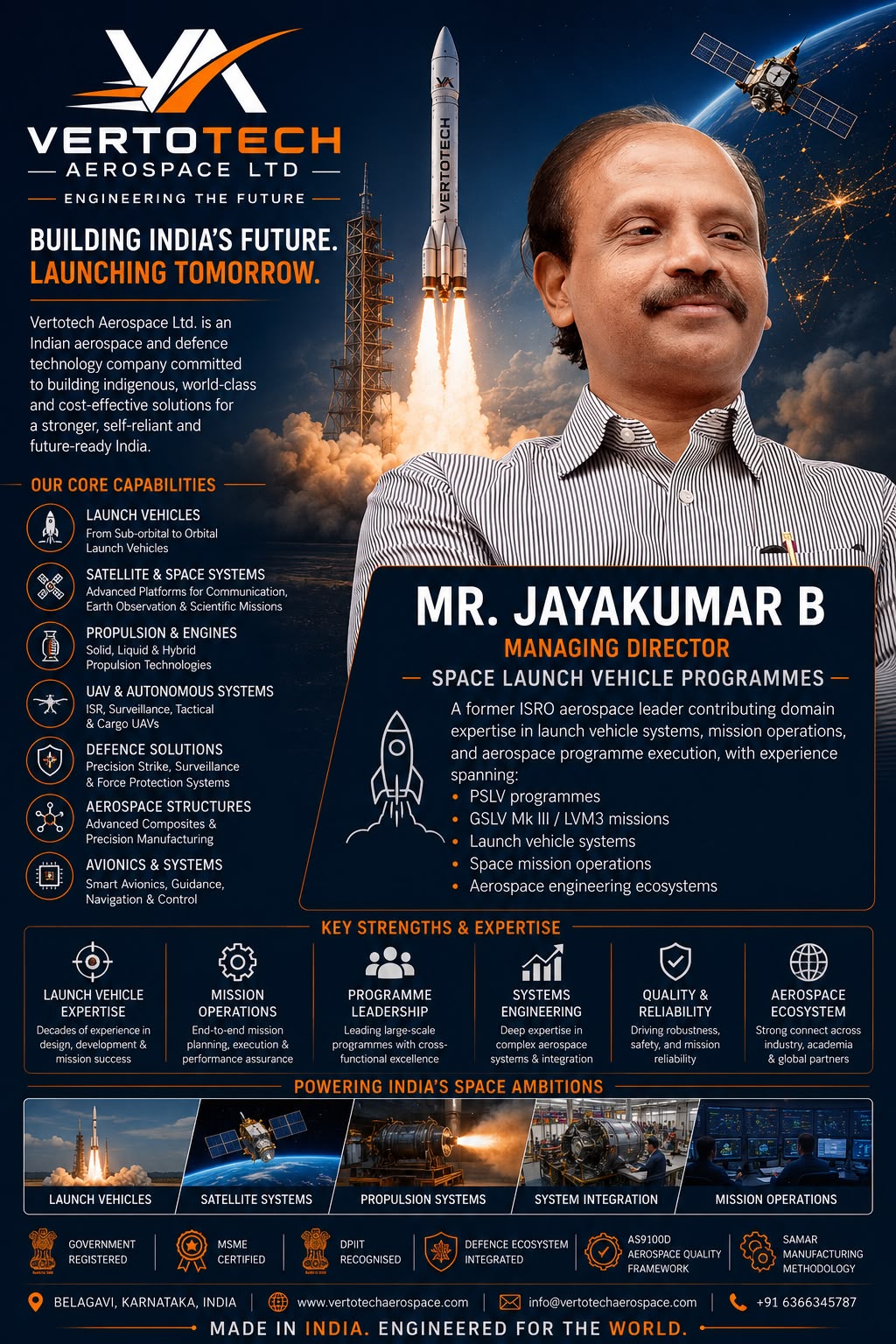
Jayakumar B
Managing Director — Space Launch Vehicle Programmes
The company’s profile associates Jayakumar B with experience in India’s launch-vehicle ecosystem, including areas associated with:
* PSLV
* GSLV Mk III / LVM3
* Launch-vehicle systems
* Mission operations
* Systems integration
* Mission planning
At Vertotech Aerospace, he contributes to the company’s launch-vehicle and orbital-systems programmes.
⸻
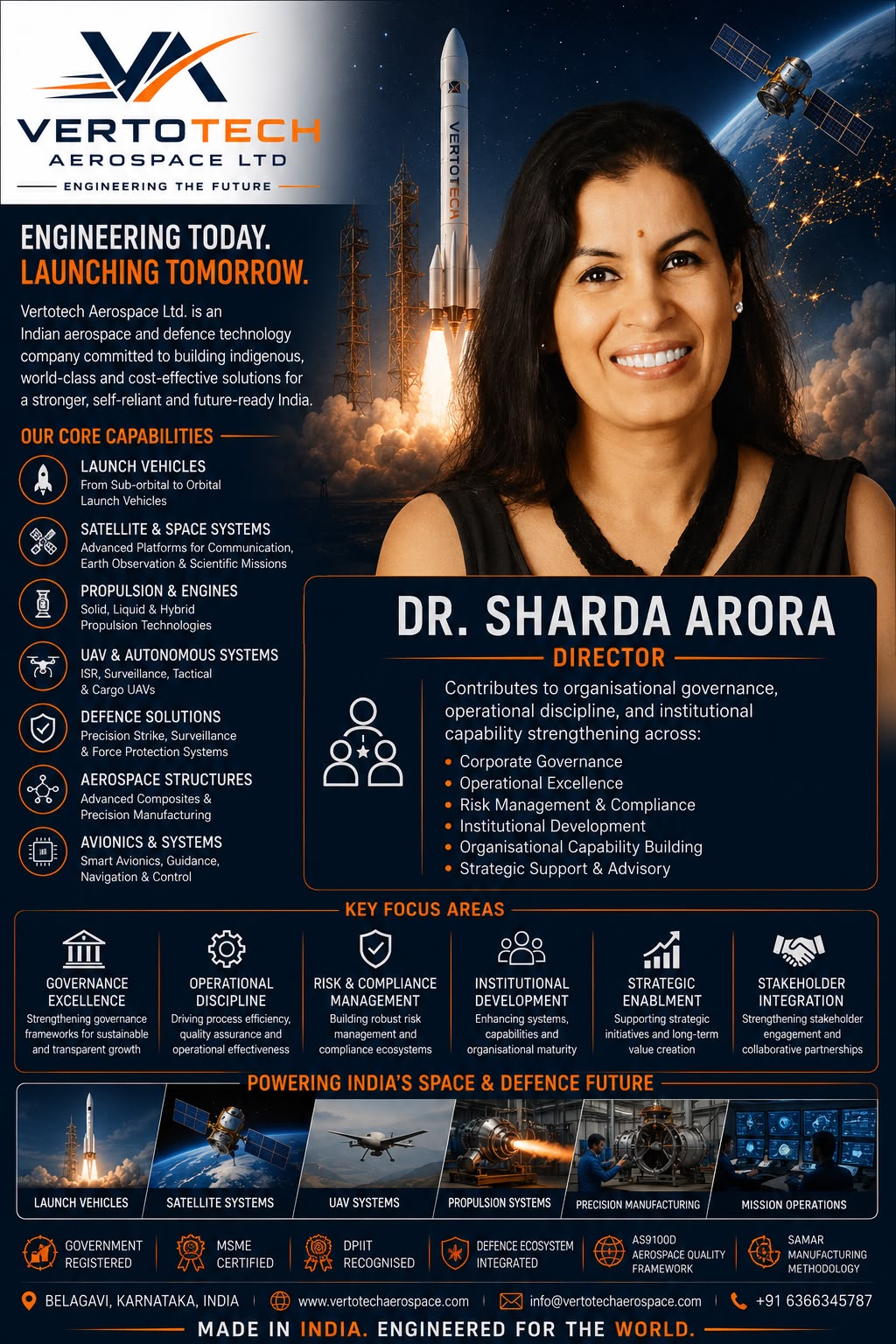
Dr. Sharda Arora
Director
Associated areas include:
* Corporate governance
* Organisational systems
* Infrastructure
* Quality-oriented processes
* Institutional development
⸻
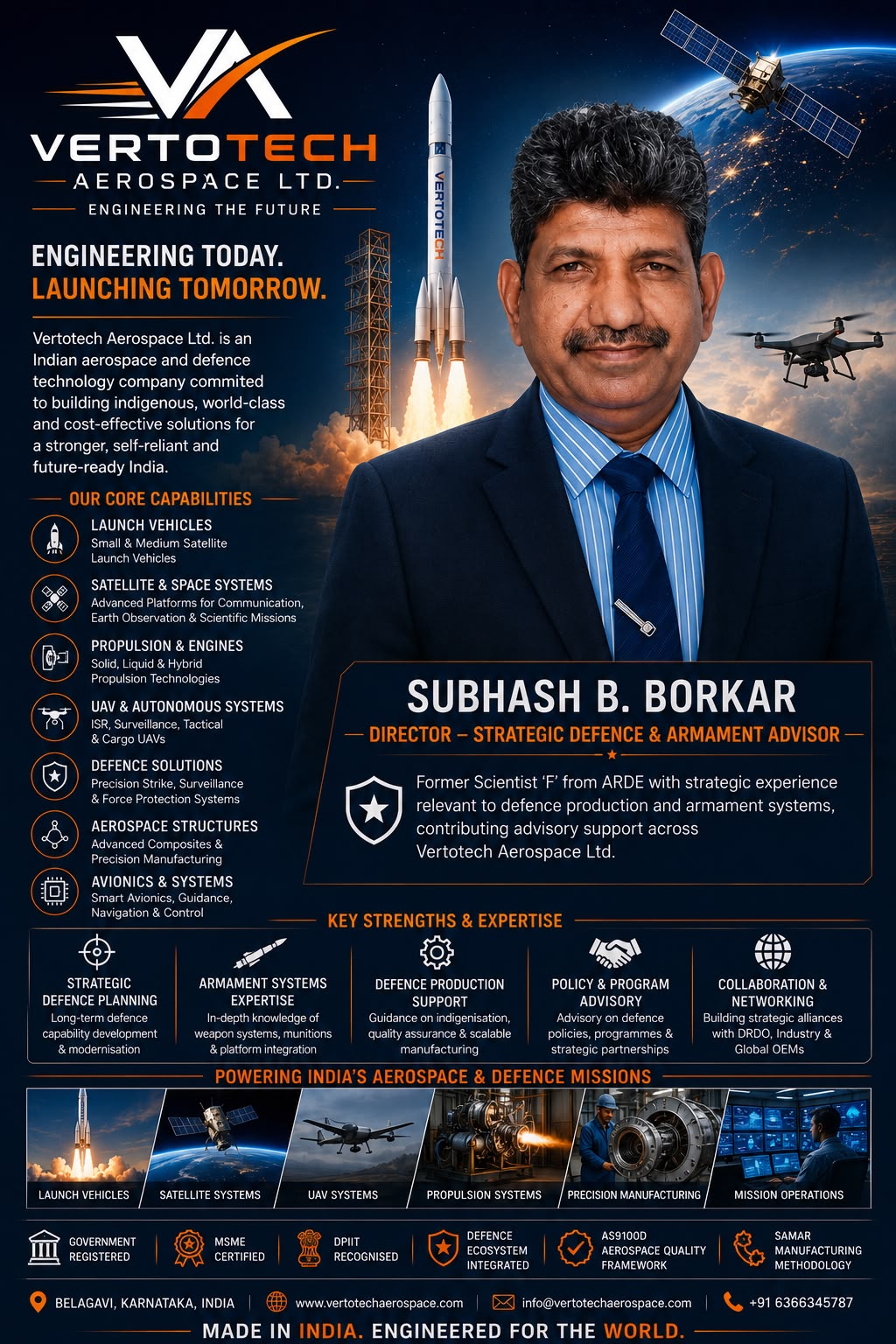
Subhash B. Borkar
Director — Strategic Defence & Armament Advisor
The company’s profile describes Subhash B. Borkar as a former Scientist ‘F’ associated with ARDE.
His stated areas of experience include:
* Defence engineering
* Armament technologies
* Launcher systems
* Defence manufacturing
* Ammunition-related manufacturing
* Strategic engineering
His role provides strategic advisory support for defence and manufacturing initiatives.
⸻
35. Corporate and Institutional Registrations
According to the supplied company profile, Vertotech Aerospace maintains the following institutional references:
Registration / Reference Number
CIN U26515KA2024PLC184496
Udyam MSME UDYAM-KR-04-0097079
GSTIN 29AAJCV9482H1ZI
IEC AAJCV9482H
Factory Establishment Certificate HUK/HUK/CE/0003/2024
RCMC — FIEO RCMC/FIEO/06367/2023–2024
DRDO SAMAR Registration SAMAR-070824-1077
CEMILAC Design Agency Application DO180625000040
DGCA Digital Sky UIN 666e6594-7edc-4413-8769-d9ac7f694669
GeM Seller ID X33S250013723516
These identifiers should be cross-checked against the relevant issuing authorities before publication as independently verified facts.
⸻
36. Registered Office
Vertotech Aerospace Limited
No. 5, 7th Main, 4th Cross
Navodaya Nagar, J.P. Nagar
Bangalore South
Bengaluru – 560078
Karnataka, India
⸻
37. Manufacturing Campus
The company’s supplied corporate information identifies its manufacturing campus at:
Survey No. 259A/1
Village: Managutti
Taluka: Hukkeri
District: Belagavi – 591243
Karnataka, India
The campus forms part of the company’s strategy to integrate engineering development with physical manufacturing.
⸻
38. Geographic Footprint
The company’s supplied profile identifies activities or offices associated with:
* Bengaluru
* Belagavi
* New Delhi
* Hyderabad
* Tamil Nadu
These locations support different engineering, manufacturing, corporate and institutional functions.
⸻
39. National Technology Alignment
Vertotech Aerospace’s stated strategic direction is aligned with India’s broader initiatives for indigenous technology and strategic manufacturing, including:
* Atmanirbhar Bharat
* Make in India
* Private-space ecosystem development
* IN-SPACe ecosystem
* Defence industrial development
* iDEX
* Technology-development programmes
* Aerospace manufacturing initiatives
Participation in any specific government programme remains subject to the relevant eligibility, approval and contractual requirements.
⸻
40. Intellectual Property and Indigenous Engineering
The company places emphasis on developing indigenous engineering knowledge and intellectual property.
Its long-term technology strategy seeks to build domestic capability in:
* Aerospace design
* Simulation
* Avionics
* Autonomous systems
* Structures
* Manufacturing
* Launch systems
* Space systems
The objective is to progressively increase the proportion of technology that can be designed, manufactured, controlled and improved within India.
⸻
41. Innovation
Vertotech Aerospace defines innovation as more than adoption of existing technology.
Its innovation framework combines:
Research + Engineering + Simulation + Manufacturing + Testing
The company seeks to use this framework to develop indigenous technologies and engineering capabilities for future aerospace applications.
⸻
42. Sovereignty
Sovereignty is the second principal pillar of the company’s corporate philosophy.
For Vertotech Aerospace, technological sovereignty means developing the domestic capability to:
* Design
* Manufacture
* Test
* Maintain
* Upgrade
* Integrate
critical aerospace technologies.
This principle is central to the company’s focus on indigenous engineering and manufacturing.
⸻
43. Reliability
Reliability is the third principal pillar.
The company emphasizes:
* Controlled engineering
* Verification
* Validation
* Traceability
* Repeatability
* Quality management
* Configuration control
* Test discipline
The objective is to develop aerospace technologies capable of progressing from experimental systems toward qualified and repeatable products.
⸻
44. Vertotech Aerospace Development Architecture
The company’s overall development architecture can be represented as:
Advanced Research
↓
Digital Engineering
↓
Simulation
↓
Aerospace Subsystems
↓
Advanced Manufacturing
↓
Systems Integration
↓
Ground Testing
↓
Flight Demonstration
↓
Qualification
↓
Scalable Aerospace Production
This architecture forms the foundation of Vertotech Aerospace’s long-term strategy.
⸻
45. Long-Term Outlook
Vertotech Aerospace’s long-term ambition is to become an Indian aerospace and strategic-technology enterprise capable of participating in multiple advanced technology sectors.
Its future-facing areas include:
* Suborbital launch systems
* Orbital launch systems
* Space subsystems
* Human-spaceflight technology research
* Advanced UAVs
* Autonomous aerospace systems
* Low-observable UAV research
* Advanced avionics
* Aerospace composites
* Digital engineering
* Strategic defence technology
* Precision manufacturing
* Propulsion-development infrastructure
The company’s future programmes remain dependent upon successful engineering development, testing, qualification, funding, manufacturing readiness and applicable regulatory approvals.
⸻
46. From Engineering to Industrial Capability
Vertotech Aerospace’s strategy can ultimately be expressed through a progression:
Knowledge
↓
Engineering
↓
Simulation
↓
Manufacturing
↓
Testing
↓
Systems
↓
Technology
↓
Strategic Capability
The company seeks to build not merely individual aerospace products, but the engineering and industrial ecosystem required to develop them.
⸻
47. Corporate Profile at a Glance
Company: Vertotech Aerospace Limited
Founded / Incorporated: 9 February 2024
Country: India
Industry: Aerospace & Advanced Engineering
Status: Government-registered MSME
Principal Domains
* Aerospace Engineering
* Space Technologies
* Launch Vehicles
* UAVs
* Autonomous Systems
* Advanced Avionics
* Aerospace Structures
* Composite Engineering
* Thermal Technologies
* Digital Engineering
* Advanced Manufacturing
* Strategic Defence Technologies
Principal Programmes
* VYAANA AAROHAN-1 / TDV-1 — approximately 10-km-class suborbital technology demonstration; target November 2026
* 200-km-class suborbital programme — approximately 50-kg-class payload target; development horizon toward end-2027
* Future orbital launch programme — targeted toward 2029
* Human-spaceflight / crew-capsule technology research
* Advanced UAV and autonomous systems
* Advanced low-observable UAV research
* Kamakaji autonomous loitering-system programme
* PARASHURAM strategic guided-system programme
* Strategic long-range guided-system research
* 155-mm-class empty-shell manufacturing programme
* South Goa aerospace propulsion and test infrastructure
Quality and Manufacturing
* AS9100D-oriented aerospace quality systems
* SAMAR-aligned manufacturing
* SAMAR Level 2 certification, subject to documentary verification
* Precision manufacturing
* Composite manufacturing
* Additive manufacturing
* Aerospace structural integration
* Testing and validation
⸻
48. Vision
To establish Vertotech Aerospace Limited as a globally respected Indian aerospace and strategic-technology enterprise contributing to sovereign aerospace capability, advanced engineering infrastructure, indigenous manufacturing excellence and future-generation aerospace innovation.
⸻
49. Mission
Vertotech Aerospace’s mission is to develop indigenous aerospace and strategic technologies through:
Advanced Research
Engineering Excellence
Simulation-Driven Development
Integrated Manufacturing
Sovereign Intellectual Property
Reliable Systems Engineering
Scalable Industrial Infrastructure
⸻
50. Corporate Philosophy
INNOVATION
Creating indigenous engineering knowledge and technology.
SOVEREIGNTY
Building domestic capability for strategically important aerospace technologies.
RELIABILITY
Developing systems through disciplined engineering, validation, traceability and quality.
⸻
✦ VERTOTECH AEROSPACE LIMITED ✦
Engineering the Future of Aerospace
Aerospace • Space • Launch Vehicles • UAVs • Autonomous Systems • Advanced Manufacturing • Strategic Technologies
From Research to Engineering.
From Simulation to Manufacturing.
From Manufacturing to Systems.
From Innovation to Sovereign Capability.
“Building indigenous aerospace capability today for the strategic technologies India will require tomorrow.”
Official Contact
Vertotech Aerospace Limited
Website: www.vertotechaerospace.com
Email: info@vertotechaerospace.com
Telephone: +91 63663 45787 | +91 831 4069328